
Tennessee Willians’s The Glass Menagerie
In Tennessee Willians’s The Glass Menagerie, a domineering mother directs the destinies of the son and daughter, thereby stifling their individualities and aspirations. The theme isn’t fresh but Tennessee Williams, with masterful strokes of his pen, draws forth the drama that tucks the hearts of audience. We feel the tension, the frustration, the struggle, and ultimately the resignation. We sympathize with the children for having to sacrifice their dreams but we also pity the mother for trying to fill the role of the father and to revive a past that no longer exists. The play is humorous, satirical, and ultimately sad.


 Leonard Seet is the author of the novels Magnolias in Paradise and Meditation On Space-Time. His short fiction have appeared in the Quarterly Literary Review Singapore, Banana Writers and Pilcrow & Dagger. Through his writings, he probes the dynamics of existence, including human consciousness, good and evil, and rationality and spirituality.
He received the B.S. in Physics and B.S. and M.S. in Electrical Engineering and Computer Science from the Massachusetts Institute of Technology, and an MBA from Georgetown University.
Leonard Seet is the author of the novels Magnolias in Paradise and Meditation On Space-Time. His short fiction have appeared in the Quarterly Literary Review Singapore, Banana Writers and Pilcrow & Dagger. Through his writings, he probes the dynamics of existence, including human consciousness, good and evil, and rationality and spirituality.
He received the B.S. in Physics and B.S. and M.S. in Electrical Engineering and Computer Science from the Massachusetts Institute of Technology, and an MBA from Georgetown University.
Kasuo Ishiguro’s The Buried Giant

Kasuo Ishiguro’s writing is magic. I usually don’t read fantasy fiction, but by creating a mesmerizing dreamscape, he turns a dragon-slaying tale into a contemplation of memory and the nature of humanity. Is the loss of memory the only way to avoid retaliation and vengeance? If we don’t forget, can we ever forgive? Furthermore, the elderly couple as unlikely protagonists in a fantasy story gives to the story repose and warmth that younger heroes couldn’t. Read The Buried Giant for the love between the protagonists. Read it for Ishiguro’s prose, which matches the dreamy milieu.
 Leonard Seet is the author of the novels Magnolias in Paradise and Meditation On Space-Time. His short fiction have appeared in the Quarterly Literary Review Singapore, Banana Writers and Pilcrow & Dagger. Through his writings, he probes the dynamics of existence, including human consciousness, good and evil, and rationality and spirituality.
He received the B.S. in Physics and B.S. and M.S. in Electrical Engineering and Computer Science from the Massachusetts Institute of Technology, and an MBA from Georgetown University.
Leonard Seet is the author of the novels Magnolias in Paradise and Meditation On Space-Time. His short fiction have appeared in the Quarterly Literary Review Singapore, Banana Writers and Pilcrow & Dagger. Through his writings, he probes the dynamics of existence, including human consciousness, good and evil, and rationality and spirituality.
He received the B.S. in Physics and B.S. and M.S. in Electrical Engineering and Computer Science from the Massachusetts Institute of Technology, and an MBA from Georgetown University.
Release of Leonard Seet’s novel Magnolias in Paradise

Ernst arrives at the Paradise train station with fifty-thousand dollars to ransom his sweetheart, and while looking among the crowd for the young man with a magnolia, a beggar seizes his bag of cash and escapes through the revolving door. Chasing after the rascal, he slams into his contact--his girlfriend's lover in town. Now, he must beat his love-rival to the money and rescue her before the deadline.
Magnolias in Paradise (252 pp., tpb, $14.95) is a 96,000-word crime novel and the first in a potential series. As in Larry Brown’s Father and Son, good confronts evil in a southern town. And as in Joe R. Lansdale’s Cold in July, an ordinary man gets sucked into a conspiracy, with psychopaths terrorizing a small town and FBI agents going after a corrupt sheriff. In the end, the man must take the law into his hands. But in this case, ending in tragedy. Here, I combined Will Christopher Baer’s surreal settings and mentally unstable villains, with Brian Evenson’s literary minimalism and heroes cursing their knowledge.
“Leonard Seet brings his intelligence and wit and gifts as a writer to a broader audience in Magnolias in Paradise in a gritty, realistic novel. He uses a narrative style which brings you the perspective of the players in this grim game of hide-and-seek reminiscent of the narrative technique of As I Lay Dying and Charming Billy… Mainstream audiences will appreciate the intelligence of the narrative of this book in this genre, which is so often short-changed by lesser lights just out to make a buck. Seet has reinvented himself as a writer in his evolution from his deeply rich, engaging and inspirational books about spirituality to the rough ride on the mean streets of Magnolias in Paradise. If you are into this genre, then you’ll definitely be engaged by this novel.” -David Lentz, author, Bloomsday: the Bostoniad
Leonard Seet is the author of the novel Meditation On Space-Time and the non-fiction The Spiritual Life. His articles and short fiction have appeared in the Quarterly Literary Review Singapore, Banana Writers and Pilcrow & Dagger. He learned the art of writing from Brando Skyhorse and Tim Johnston through George Washington University's Jennie McKean Moore Fiction Workshop, which is by application.
Magnolias in Paradise is available in most brick-and-mortar and online bookstores.
Leonard Seet is the author of the novels Magnolias in Paradise and Meditation On Space-Time. His short fiction have appeared in the Quarterly Literary Review Singapore, Banana Writers and Pilcrow & Dagger. Through his writings, he probes the dynamics of existence, including human consciousness, good and evil, and rationality and spirituality.
He received the B.S. in Physics and B.S. and M.S. in Electrical Engineering and Computer Science from the Massachusetts Institute of Technology, and an MBA from Georgetown University.
Review of Tim O’Brien’s The Things They Carried
Tim O’Brien’s experience equipped him to tell powerful, emotional stories about the soldiers who fought in the Vietnam War. This book is a tribute to them. O’Brien’s no-nonsense prose comes through like a lightning flash in the night sky.
“… I detest their blind, thoughtless, automatic acquiescence to it all, their simpleminded patriotism, their prideful ignorance, their love-it-or-leave-it platitudes, how they were sending me off to fight a war they didn’t understand and didn’t want to understand. … the polyestered Kiwanis boys, the merchants and farmers, the pious churchgoers, the chatty housewives, the PTA and the Lions club and the Veterans of Foreign Wars and the fine upstanding gentry out at the country club. They didn’t know Bao Dai from the man in the moon. They didn’t know history. They didn’t know the first thing about Diem’s tyranny, or the nature of Vietnamese nationalism, or the long colonialism of the French… but no matter, it was a war to stop the Communists, plain and simple, which was how they like things, you were a treacherous pussy if you had second thoughts about killing or dying for plain and simple reasons.”

Perhaps, only someone like O’Brien, who had fought in the war, could understand the struggles these soldiers must confront.
“All those eyes on me--the town, the whole universe--and I couldn’t risk the embarrassment. It was as if there were an audience to my life, that swirl of faces along the river, and in my head I could hear people screaming at me. Traitor! they yelled. Turncoat! Pussy! I felt myself blush. I couldn’t tolerate it. I couldn’t endure the mockery, or the disgrace, or the patriotic ridicule.”

What is courage, which is especially important for a soldier? Here, the narrator, in the story “On the Rainy River,” says, “I was a coward. I went to the war.” Could there be a sadder or more powerful statement on courage?
To read the stories in The Things They Carried is to enter the world of these soldiers. And O’Brien is a masterful storyteller.
“… I detest their blind, thoughtless, automatic acquiescence to it all, their simpleminded patriotism, their prideful ignorance, their love-it-or-leave-it platitudes, how they were sending me off to fight a war they didn’t understand and didn’t want to understand. … the polyestered Kiwanis boys, the merchants and farmers, the pious churchgoers, the chatty housewives, the PTA and the Lions club and the Veterans of Foreign Wars and the fine upstanding gentry out at the country club. They didn’t know Bao Dai from the man in the moon. They didn’t know history. They didn’t know the first thing about Diem’s tyranny, or the nature of Vietnamese nationalism, or the long colonialism of the French… but no matter, it was a war to stop the Communists, plain and simple, which was how they like things, you were a treacherous pussy if you had second thoughts about killing or dying for plain and simple reasons.”

Perhaps, only someone like O’Brien, who had fought in the war, could understand the struggles these soldiers must confront.
“All those eyes on me--the town, the whole universe--and I couldn’t risk the embarrassment. It was as if there were an audience to my life, that swirl of faces along the river, and in my head I could hear people screaming at me. Traitor! they yelled. Turncoat! Pussy! I felt myself blush. I couldn’t tolerate it. I couldn’t endure the mockery, or the disgrace, or the patriotic ridicule.”

What is courage, which is especially important for a soldier? Here, the narrator, in the story “On the Rainy River,” says, “I was a coward. I went to the war.” Could there be a sadder or more powerful statement on courage?
To read the stories in The Things They Carried is to enter the world of these soldiers. And O’Brien is a masterful storyteller.
Leonard Seet is the author of the novels Magnolias in Paradise and Meditation On Space-Time. His short fiction have appeared in the Quarterly Literary Review Singapore, Banana Writers and Pilcrow & Dagger. Through his writings, he probes the dynamics of existence, including human consciousness, good and evil, and rationality and spirituality.
He received the B.S. in Physics and B.S. and M.S. in Electrical Engineering and Computer Science from the Massachusetts Institute of Technology, and an MBA from Georgetown University.
Dennis Lehane's Shutter Island
Teddy Daniels goes to Shutter Island to locate Rachel Solando, a psychiatric patient in Ashecliffe Hospital who has disappeared from a guarded cell. No one knows how she escaped and no one knows where she could be. Teddy suspects the staff conspired to make her disappear but they wouldn’t let him review the patient list. When he keeps finding cryptic codes, he suspects the hospital is experimenting on the psychotic criminals by operating on their brains. But nothing is what it seems. Soon, he cannot distinguish between reality and illusion. The doctors there begin to imply that he may be insane.

Shutter Island is a page-turner of a novel. Nothing is what it seems and the boundary between reality and illusion blurs. Did Rachel Solando really escaped? Who is leaving the code for Teddy? Is the hospital operating on the patients to eliminate their violence? Is Teddy going insane? The truth is a surprising twist and the reader will enjoy the ride.

Shutter Island is a page-turner of a novel. Nothing is what it seems and the boundary between reality and illusion blurs. Did Rachel Solando really escaped? Who is leaving the code for Teddy? Is the hospital operating on the patients to eliminate their violence? Is Teddy going insane? The truth is a surprising twist and the reader will enjoy the ride.
 Leonard Seet is the author of the novels Magnolias in Paradise and Meditation On Space-Time. His short fiction have appeared in the Quarterly Literary Review Singapore, Banana Writers and Pilcrow & Dagger. Through his writings, he probes the dynamics of existence, including human consciousness, good and evil, and rationality and spirituality.
He received the B.S. in Physics and B.S. and M.S. in Electrical Engineering and Computer Science from the Massachusetts Institute of Technology, and an MBA from Georgetown University.
Leonard Seet is the author of the novels Magnolias in Paradise and Meditation On Space-Time. His short fiction have appeared in the Quarterly Literary Review Singapore, Banana Writers and Pilcrow & Dagger. Through his writings, he probes the dynamics of existence, including human consciousness, good and evil, and rationality and spirituality.
He received the B.S. in Physics and B.S. and M.S. in Electrical Engineering and Computer Science from the Massachusetts Institute of Technology, and an MBA from Georgetown University.
A Very Easy Death
In A Very Easy Death, Simone De Beauvoir said, “She (her mother) had a very easy death; an upper class death.” But it wasn’t an easy death. In this frank account of her mother’s struggle with intestinal cancer, Beauvoir not only reveals the struggle to release our loved ones but also the lies that we sometime perpetrate to spare them of suffering. The process of dying was gruesome, even for her mother, who wanted to keep a stiff upper lip. Worse were the doctors whose only goal was to keep the patient alive, regardless of pain and suffering, both physical and emotional. “… even when I was holding Maman’s hand, I was not with her -- I was lying to her.” Her mother losing her dignity as a human being is one of the most disheartening parts of the account. For many, like Beauvoir’s mother, dying may be a far worse ordeal than death. A must read for anyone who wants to prepare for and face death.

 Leonard Seet is the author of the novels Magnolias in Paradise and Meditation On Space-Time. His short fiction have appeared in the Quarterly Literary Review Singapore, Banana Writers and Pilcrow & Dagger. Through his writings, he probes the dynamics of existence, including human consciousness, good and evil, and rationality and spirituality.
He received the B.S. in Physics and B.S. and M.S. in Electrical Engineering and Computer Science from the Massachusetts Institute of Technology, and an MBA from Georgetown University.
Leonard Seet is the author of the novels Magnolias in Paradise and Meditation On Space-Time. His short fiction have appeared in the Quarterly Literary Review Singapore, Banana Writers and Pilcrow & Dagger. Through his writings, he probes the dynamics of existence, including human consciousness, good and evil, and rationality and spirituality.
He received the B.S. in Physics and B.S. and M.S. in Electrical Engineering and Computer Science from the Massachusetts Institute of Technology, and an MBA from Georgetown University.
Ray Bradbury’s The Martian Chronicles
Ray Bradbury’s Martians aren’t microbes, or insects, or energy forms. They have brown skin, yellow eyes, and russet hair, and can be romantic (Mrs. K) or jealous (Mr. K). Though they are telepathic and live in crystal structures, they resemble humans more than amebas. Mars’s atmosphere sustains human life: the settlers didn’t wear any masks or respirators. Therefore, the air has oxygen and not much toxic gas such as chlorine and carbon monoxide. And the air pressure doesn’t much from that of earth. There is water though at least one sea dried out and there are sand vessels to surf through the desert. In many way, Bradbury’s Mars resembles a skewed version of earth. It is a romantic vision of the next frontier.

In contrast, wars permeate Earth and nuclear weapons were destroying the land to such an extent that some decided to leave Earth for Mars.
The colonists fled earth and settled in Mars and they create towns in their own images. The settlements resemble American mid-western suburbs of the 40’s and 50’s with ranches and gardens and the idyllic life. Like the colonialists on earth, the first visitors to Mars brought diseases that killed most of the natives. The settlers claim the land as their own and drove the remaining native into the hills.

In the section “The Million-Year Picnic,” the dad said to his children, “Now we’re alone. We and a handful of others who’ll land in a few days. Enough to start over. Enough to turn away from all that back on Earth and strike out on a new line--” The Puritans who came to the new world probably had the same vision.

In The Martian Chronicles, Ray Bradbury shows how the settlers try to escape the evil on Earth only to bring the same seed of destruction to another land by creating it in their own images.

In contrast, wars permeate Earth and nuclear weapons were destroying the land to such an extent that some decided to leave Earth for Mars.
The colonists fled earth and settled in Mars and they create towns in their own images. The settlements resemble American mid-western suburbs of the 40’s and 50’s with ranches and gardens and the idyllic life. Like the colonialists on earth, the first visitors to Mars brought diseases that killed most of the natives. The settlers claim the land as their own and drove the remaining native into the hills.

In the section “The Million-Year Picnic,” the dad said to his children, “Now we’re alone. We and a handful of others who’ll land in a few days. Enough to start over. Enough to turn away from all that back on Earth and strike out on a new line--” The Puritans who came to the new world probably had the same vision.

Ray Bradbury (Photo: Alan Light)
In The Martian Chronicles, Ray Bradbury shows how the settlers try to escape the evil on Earth only to bring the same seed of destruction to another land by creating it in their own images.
Leonard Seet is the author of the novels Magnolias in Paradise and Meditation On Space-Time. His short fiction have appeared in the Quarterly Literary Review Singapore, Banana Writers and Pilcrow & Dagger. Through his writings, he probes the dynamics of existence, including human consciousness, good and evil, and rationality and spirituality.
He received the B.S. in Physics and B.S. and M.S. in Electrical Engineering and Computer Science from the Massachusetts Institute of Technology, and an MBA from Georgetown University.
On Grief and Grieving Review
In On Grief and Grieving, Elizabeth Kubler-Ross applies the Five Stages model from her book On Death and Dying to grieving. Those who grieve while a loved one is dying or afterwards also struggle with denial, anger, bargaining, depression and acceptance. While she confronts her own death, Ms. Kubler-Ross, together with co-author David Kessler, shares the inner and outer worlds of grief. For those who have grieved, some and perhaps many of the issues are familiar. We may be emotionally drained; we may feel relieved to see our loved one no longer suffering but then guilt may overwhelm us. During anniversaries and holidays, we would be especially pained. The book helps us grapple with our grieving and lets us know that we are not alone in the struggles. For those who are grieving as well as those who had grieved and those who will grieve.
Leonard Seet is the author of the novels Magnolias in Paradise and Meditation On Space-Time. His short fiction have appeared in the Quarterly Literary Review Singapore, Banana Writers and Pilcrow & Dagger. Through his writings, he probes the dynamics of existence, including human consciousness, good and evil, and rationality and spirituality.
He received the B.S. in Physics and B.S. and M.S. in Electrical Engineering and Computer Science from the Massachusetts Institute of Technology, and an MBA from Georgetown University.
A Short Review of @House of Leaves

At one level, @
To say that @

Sample Page from Novel 1
However, he didn’t sacred story for format. The Navidson Record is gripping surrealist ho…or…roo…or[8] story. We rue for Navidson as he and his team journey into the malleable space of the @house and as he and Karen struggle with their relationship. We mourn the loss of his brother Tom and lament Navidson’s determination to enter alone into that dark hallway, his Moby Dick[10]. Navidson and Karen are characters who struggle with their dark souls and the @house is the symbol that reflects the darkness. The @house is one of the most memorable non-human characters in fiction. It is alive. It reflects the darkness of those who enter it. But also, it represents the force of nature: random, chaotic, and XXXXX[11].

Sample Page from Novel 2
At the meta-level, Johnny Truant’s story is also compelling. Though at first Truant seems like a shallow character, even in the beginning, we see in Truant’s prose a mixture of the lyrical and the crude, which foreshadows his schizophrenia. The Whalestoe Letters, letter from his mother, reveal her troubled mind and also hinted at his. In those letters, Danielewski uses layout and format to show her descend into insanity. Likewise, the chrolonogy mentfraged in entries lanruoj Truant’s woshs mind his oozing ouch with time/emit.
@House of Leaves is a modern master…master…piece. If… if… you like Borges… Borges… you… you will… will… love… love… love… le…[12]*
* Since Blogspot does not support all the formats in the manuscript, we have attached Exhibits I and II to show the original review. –Ed.
-----------------------------------------------------------------------------------------------------------
1. Danielewski, Mark, @
2. Nabokov, Vladimir, Pale Fire (MCMLXII). G. P. Putnam’s Sons, New York.
3. See @
4. See Leonard Seet’s review of Jorge Luis Borges’s Labyrinth.
5. By postmodern, we mean the rebellion against pre-modernism’s reliance on authority whether they be gods or priests or kings or feudal lords, and modernism’s worship of the individual, reason and science.[6]
6. We have EDITED Leonard Seet’s spiel on postmodernism, which spanned six pages and twenty-eight lines. There have been enough arguments about what we mean by postmodern, just as there were enough bickering about PARA-digm sh-----ift, that we can lay them to ZZZZ for now. –Ed.
7. We have not checked whether anyone has claimed this hashtag in Twitter. –Ed.
8. For an analysis of how Navidson exploited the techniks of horror in film, see The Navidson Record.[9]
9. We believe this is an error. Disclaimer: we do not endorse self-referential loop in logical discourse. That is not to say we dismiss M. C. Escher’s drawings such as Relativity and Drawing Hands, for art is different from yada yada. -Ed.
10. The whale, not the restaurant chain.
11. We have EDITED out the word to comply with Blogspot’s censor on reviews. –Ed.
12. Apparently, time began to dilate while Mr. Seet was finishing his review, just as the space expanded when Navidson entered the hallway. And as @

Exhibit I: Original Review Page 1

Exhibit II: Original Review Page 2
Leonard Seet is the author of the novels Magnolias in Paradise and Meditation On Space-Time. His short fiction have appeared in the Quarterly Literary Review Singapore, Banana Writers and Pilcrow & Dagger. Through his writings, he probes the dynamics of existence, including human consciousness, good and evil, and rationality and spirituality.
He received the B.S. in Physics and B.S. and M.S. in Electrical Engineering and Computer Science from the Massachusetts Institute of Technology, and an MBA from Georgetown University.
On Death and Dying Review by Elisabeth Kübler-Ross
It has become cliché to say we live in a society that denies death. From her experiences with dying patients, Elisabeth Kübler-Ross sheds insight into how we face, or not face, death. She details the famous Five Stages --denial and isolation, anger, bargaining, depression, acceptance--through case studies of patients. The Kübler-Ross Model, for better or worse, have become the model from which academics and lay people understand the process of dying. But more than the model, the book forces us to gaze death in the eyes and confront our fears. Only then can we integrate death into life and realize that death is part of our life and indeed a vital part. If we deny it or even just neglect it, our lives become incomplete. We don’t have to obsess over death just as we don’t just focus on our health to the neglect of other parts of lives. When death becomes an integral part of our beings, our lives become more dynamic.
Great insight into the psychology toward our ultimate end. On Death and Dying is not only for those facing death and their close ones, but for everyone, to prepare our journey to the end, and thus to gain strength in living our lives and in caring for those around us.
Great insight into the psychology toward our ultimate end. On Death and Dying is not only for those facing death and their close ones, but for everyone, to prepare our journey to the end, and thus to gain strength in living our lives and in caring for those around us.
Leonard Seet is the author of the novels Magnolias in Paradise and Meditation On Space-Time. His short fiction have appeared in the Quarterly Literary Review Singapore, Banana Writers and Pilcrow & Dagger. Through his writings, he probes the dynamics of existence, including human consciousness, good and evil, and rationality and spirituality.
He received the B.S. in Physics and B.S. and M.S. in Electrical Engineering and Computer Science from the Massachusetts Institute of Technology, and an MBA from Georgetown University.
Philip K. Dick’s The Man in the High Castle
In a world where the Axis powers won W.W.II, Germany rules Europe and Japan Asia and the Pacific and they split the United States. Then, as in the Cold War, Germany and Japan rival for world domination. But the playground is the U.S. rather than Germany. The Man in the High Castle takes place in Japan-controlled San Francisco and the neutral Rocky Mountain States between the Pacific States of America and the East Coast of America. Germany plans to subdue Japan by creating an incident in the Rocky Mountain States, but a faction within the government sends a spy to warn Japan. In this world Germany’s final solution in Africa wipes out the continent and the country continues to persecute the Jews throughout the world, the remnants fleeing to the Rocky Mountain States and the Pacific States of America. The I Ching, the oracle that has replaced Christianity and the horoscope in the Pacific State of America, guides the masses in their decisions and through the ancient Chinese scripts answers their questions about life and death and the vagaries of living. This ancient scripture consumes the people’s imagination. In The Man in the High Castle, Philip K. Dick created a world where the power players have shifted roles but familiar brinkmanship and subterfuge remain.

Within the novel is another book, The Grasshopper Lies Heavy by Hawthorne Abendsen, the man in the high castle. This novel within a novel delineates an alternative history to the one above. What if Germany and Japan lost W.W.II? Not a Cold War between the U.S. and U.S.S.R. Not the victory of the communists in China. Rather, The Nationalist defeats the Communists in China, establishes a right-wing regime and allies with the U.S. The British retains most of its empire and continues to expand its dominance. Indeed, a Cold War develops between the U.S. and the U.K. with the latter eventually dominating the former. What is interesting is that this alternative to an alternative isn’t our history. So even with Allies victory, many scenarios can play out.

Dick’s comment on the Nazis is thought provoking.
“They want to be the agents, not the victims, of history. They identify with God's power and believe they are godlike. That is their basic madness. They are overcome by some archetype; their egos have expanded psychotically so that they cannot tell where they begin and the godhead leaves off. It is not hubris, not pride; it is inflation of the ego to its ultimate — confusion between him who worships and that which is worshiped. Man has not eaten God; God has eaten man.”
The Man in the High Castle is not just science fiction, but a thought-provoking look into the nature of humanity. Of course, as with other works of Dick, the cultural nuances and biases of the 60’s rear their heads throughout the novel. Nevertheless, a novel worth reading.

The World in The Man in the High Castle
Within the novel is another book, The Grasshopper Lies Heavy by Hawthorne Abendsen, the man in the high castle. This novel within a novel delineates an alternative history to the one above. What if Germany and Japan lost W.W.II? Not a Cold War between the U.S. and U.S.S.R. Not the victory of the communists in China. Rather, The Nationalist defeats the Communists in China, establishes a right-wing regime and allies with the U.S. The British retains most of its empire and continues to expand its dominance. Indeed, a Cold War develops between the U.S. and the U.K. with the latter eventually dominating the former. What is interesting is that this alternative to an alternative isn’t our history. So even with Allies victory, many scenarios can play out.

Dick’s comment on the Nazis is thought provoking.
“They want to be the agents, not the victims, of history. They identify with God's power and believe they are godlike. That is their basic madness. They are overcome by some archetype; their egos have expanded psychotically so that they cannot tell where they begin and the godhead leaves off. It is not hubris, not pride; it is inflation of the ego to its ultimate — confusion between him who worships and that which is worshiped. Man has not eaten God; God has eaten man.”
The Man in the High Castle is not just science fiction, but a thought-provoking look into the nature of humanity. Of course, as with other works of Dick, the cultural nuances and biases of the 60’s rear their heads throughout the novel. Nevertheless, a novel worth reading.
Leonard Seet is the author of the novels Magnolias in Paradise and Meditation On Space-Time. His short fiction have appeared in the Quarterly Literary Review Singapore, Banana Writers and Pilcrow & Dagger. Through his writings, he probes the dynamics of existence, including human consciousness, good and evil, and rationality and spirituality.
He received the B.S. in Physics and B.S. and M.S. in Electrical Engineering and Computer Science from the Massachusetts Institute of Technology, and an MBA from Georgetown University.
Ursula K. Le Guin's The Ones Who Walk Away from Omelas

Omelas's citizens have all the blessings we could imagine and they are cultured and wise but the price of having these good fortunes is one child's misery. A "scapegoat" to take on the "sins" of the city. Similar to the Biblical idea of the Savior taking on the sins of the world.
Though at first appalled at the barbarity of such a bargain, we may begin to realize that in our civilization, though not in such an extreme way, the majority benefits from those who sacrifice to make their lives better.

Ursula K. Le Guin (Photo by Eileen Gunn)
Policemen and policewomen put their lives on the line so we may live in a safer society and though we pay taxes for their services and they choose their profession, we are nevertheless benefiting from their "sacrifices."
Adults and children from Bangladesh may choose to work in garment factories but they didn't choose the poverty they were born into. And we as a society benefit from the relatively cheap clothing.
We may avoid buying clothes from Bangladesh but if we are to live in a society we cannot avoid benefiting from others' services. Ursula K. Le Guin's tale reminds us that our blessings come at a cost but also cautions us not to move toward Omelas, that "utopian dystopia." As in Omelas, some will choose to walk away from our society. But if they try to form another utopia, they will face similar dilemmas. That is not to say that we shouldn't look for solutions, but that those who walk away will bring the problem to their paradise.
Leonard Seet is the author of the novels Magnolias in Paradise and Meditation On Space-Time. His short fiction have appeared in the Quarterly Literary Review Singapore, Banana Writers and Pilcrow & Dagger. Through his writings, he probes the dynamics of existence, including human consciousness, good and evil, and rationality and spirituality.
He received the B.S. in Physics and B.S. and M.S. in Electrical Engineering and Computer Science from the Massachusetts Institute of Technology, and an MBA from Georgetown University.
Patrick Süskind's Perfume
Jean-Baptiste Grenouille has no scent but can identify the minutest one. To create a perfume that would seduce people into loving and worshiping him, he searches far and wide for the perfect ingredient. When he found that scent on a teenage girl, he intended to extract it from her even if that meant killing her.

In Perfume, Patrick Süskind has created a Gothic tale as dark as Frankenstein, but a tale of creation of the perfect perfume rather than the perfect man. Scents and fragrances dominate the book and details of the extraction processes make the book a good read. But Grenouille is a greater monster than Dr. Frankenstein’s creation. Through his misery and suffering, Grenouille learned to hate humanity and to take revenge upon it. He has no conscience and his only goal is to create the perfect perfume. If he had to kill innocent girls, so be it. He aspires to be God. He wanted the people to love and worship him. He succeeds. He becomes all-powerful, but without his own smell, he has no identity. That is his grief. In the end, he destroys himself.

In Perfume, Patrick Süskind has created a Gothic tale as dark as Frankenstein, but a tale of creation of the perfect perfume rather than the perfect man. Scents and fragrances dominate the book and details of the extraction processes make the book a good read. But Grenouille is a greater monster than Dr. Frankenstein’s creation. Through his misery and suffering, Grenouille learned to hate humanity and to take revenge upon it. He has no conscience and his only goal is to create the perfect perfume. If he had to kill innocent girls, so be it. He aspires to be God. He wanted the people to love and worship him. He succeeds. He becomes all-powerful, but without his own smell, he has no identity. That is his grief. In the end, he destroys himself.
Leonard Seet is the author of the novels Magnolias in Paradise and Meditation On Space-Time. His short fiction have appeared in the Quarterly Literary Review Singapore, Banana Writers and Pilcrow & Dagger. Through his writings, he probes the dynamics of existence, including human consciousness, good and evil, and rationality and spirituality.
He received the B.S. in Physics and B.S. and M.S. in Electrical Engineering and Computer Science from the Massachusetts Institute of Technology, and an MBA from Georgetown University.
Ten With a Flag by Joseph Paul Haines

We’re learning more and more about embryos through DNA mapping and technologies will advance to give us more information about a fetus’s health and perhaps its innate skills. Should parents get and view the information? What should they do if they find out their baby has a high risk of heart attack or Alzheimer’s disease? A situation similar to whether we should look into the future if we can. Will the information help us plot a course to minimize the risks? Or will it stifle us with fear and worry? And what are the moral implications? These are not easy questions though in general we should go through life with our eyes open. But we are humans and we fear and worry and indeed sometimes knowledge chokes us. May we have the wisdom and maturity for greater knowledge.
Leonard Seet is the author of the novels Magnolias in Paradise and Meditation On Space-Time. His short fiction have appeared in the Quarterly Literary Review Singapore, Banana Writers and Pilcrow & Dagger. Through his writings, he probes the dynamics of existence, including human consciousness, good and evil, and rationality and spirituality.
He received the B.S. in Physics and B.S. and M.S. in Electrical Engineering and Computer Science from the Massachusetts Institute of Technology, and an MBA from Georgetown University.
Shirley Jackson's The Lottery
In Shirley Jackson’s The Lottery, though the stoning reminds us of the Old Testament punishment, its original intent has long been forgotten. We view with horror at the barbarity and insanity of the custom, just as we consider the Romans barbaric for entertaining themselves with gladiators. But perhaps a visitor to the U.S. without previous exposure may find American football, shoulders banging into heads and players piling on top of each other, also “barbaric and insane.”

We do not question our customs and habits just as the villagers in the story do not theirs. What we view as “normal living” may be considered insanity to foreigners, and vice versa.
We sit in the traffics for hours, stare at the TV or computer or tablet until bedtime, and text 24/7 to feel connected with some body. Just because everyone else is doing it? Just because our parents or grandparents have been doing it for years? Just because TV ads tell us it’s the good life? Or because it’s the path of least resistance?
Through Jackson’s story, the reader reflects on his or her customs and habits, most of which are detrimental only when gone through without understanding their purposes. We may realize how silly some of our routines are. And also others’ habits and customs may no longer be as “strange.”

We do not question our customs and habits just as the villagers in the story do not theirs. What we view as “normal living” may be considered insanity to foreigners, and vice versa.
We sit in the traffics for hours, stare at the TV or computer or tablet until bedtime, and text 24/7 to feel connected with some body. Just because everyone else is doing it? Just because our parents or grandparents have been doing it for years? Just because TV ads tell us it’s the good life? Or because it’s the path of least resistance?
Through Jackson’s story, the reader reflects on his or her customs and habits, most of which are detrimental only when gone through without understanding their purposes. We may realize how silly some of our routines are. And also others’ habits and customs may no longer be as “strange.”
Leonard Seet is the author of the novels Magnolias in Paradise and Meditation On Space-Time. His short fiction have appeared in the Quarterly Literary Review Singapore, Banana Writers and Pilcrow & Dagger. Through his writings, he probes the dynamics of existence, including human consciousness, good and evil, and rationality and spirituality.
He received the B.S. in Physics and B.S. and M.S. in Electrical Engineering and Computer Science from the Massachusetts Institute of Technology, and an MBA from Georgetown University.
The Blue Religion: New Stories about Cops, Criminals, and the Chase Edited by Michael Connelly

The collection of police crime fiction includes Law & Order type police procedural such as Persia Walker’s “Such a Lucky, Pretty Girl” to capers such as Bev Vincent’s “Rule Number One.” But all the stories are about cops and criminals and the onus and responsibility of the badge. And there is even a provocative story by Diana Hansen-Young, “Oaths, Ohana, and Everything,” about the handing-over of Hawaii to the United States. A great collection for crime fiction fans.
Leonard Seet is the author of the novels Magnolias in Paradise and Meditation On Space-Time. His short fiction have appeared in the Quarterly Literary Review Singapore, Banana Writers and Pilcrow & Dagger. Through his writings, he probes the dynamics of existence, including human consciousness, good and evil, and rationality and spirituality.
He received the B.S. in Physics and B.S. and M.S. in Electrical Engineering and Computer Science from the Massachusetts Institute of Technology, and an MBA from Georgetown University.
Philip K. Dick's The Minority Report

Anderton is the commissioner and founder of Precrime, the police force that arrests criminals before they have a chance to commit crime. Computers manipulate “gibberish” from three “precogs,” each one seeing into a possible future, and Anderton determines whether a crime will be committed. When two or more “precogs” agree on an outcome, the resulting agreement is a majority report and the police can act on it. The system has been working fine until one day a majority report indicates Anderton will murder a retired general.
When he reviews the reports and tried to understand how the minority report differs from the majority. He realizes the fact that he, unlike other criminals, could see the report has altered the results. The first report gives the situation where he doesn’t know he will kill the general and in this scenario he would kill the general to prevent the military from taking over. But the second report, the minority report, considers his seeing the first report and therefore changing the outcome and in this scenario he wouldn’t kill the general. Then the third report, which consider his seeing the minority report, indicates he would kill the general. The very fact that he could see into the “future” changes it.

In this story, Philip K. Dick questions the validity of “seeing into the future.” If we could “see into the future,” we have the opportunity to change that future and therefore create a different future. Hence, the paradox.
I enjoy reading Philip K. Dick because his stories spurs to think about issues in our existence. In Do Androids Dream of Electric Sheep?, it is the nature of being alive and being human. In Ubik, it the nature of reality. And here, it is the paradox of knowing the future.
Leonard Seet is the author of the novels Magnolias in Paradise and Meditation On Space-Time. His short fiction have appeared in the Quarterly Literary Review Singapore, Banana Writers and Pilcrow & Dagger. Through his writings, he probes the dynamics of existence, including human consciousness, good and evil, and rationality and spirituality.
He received the B.S. in Physics and B.S. and M.S. in Electrical Engineering and Computer Science from the Massachusetts Institute of Technology, and an MBA from Georgetown University.
Stephen King's Novel 11/22/63
When Jake Eppings, a high school teacher in Lisbon Falls, Maine visits Al, the owner of a local diner, the latter reveals a time tunnel in the diner’s kitchen, which could take him back to September 9, 1958, specifically at 11:58 a.m. Al has traveled through the tunnel several times to buy cheap beef for his diner but in his latest trip, he tried to prevent John F. Kennedy’s assassination. When his health begins to deteriorate, he returns to tell Jake everything and asks the teacher to take on the mission. Jake at first hesitates but eventually agrees to save Kennedy from Lee Harvey Oswald, and using Al’s notes, he carries out the plan to stop the assassin. What Jake didn’t realize is changing such a momentous event redirects the course of history, the Butterfly Effect.

Time travel isn’t new in literature and through nitpicking we can always find technical flaws. In this case, given the asymmetry of the time tunnel, it is interesting to ask: if someone at Lisbon Falls on September 9, 1958 steps into the “rabbit hole” what date and time would she emerge into?

But nitpicking aside, Stephen King, through his research, succeeds in painting a picture of the cultural and social environment during the late 50s and early 60s, particularly in Maine and around the Dallas/Fort Worth area. King has delayed writing the novel for years because he needs time to research that era and he has succeed in the effort and written a novel that immerses the reader in the local climate of that period. And the characters come alive because of the local flavors.

After reading the novel, the reader would reflect on the causality of historical events, i.e. the Butterfly Effect on a global scale. What if Hitler didn’t rise to power? What if Gandhi remained a lawyer in South Africa? Would the world be better or worse in either case? We don’t know. We observe a triumph or a tragedy in history and we evaluate it according to our values and biases but a triumph may lead to a catastrophe and a tragedy a breakthrough. I wonder whether one day our supercomputers can predict the course of human history through Genetic Algorithms, Dynamic Programming, and other stochastic estimation methods. But at any moment in history, without knowing the “global optimum,” we like Jake Eppings would still strive for the “best” according to our values. We are human. We are only human.

John F Kennedy in Dallas, Texas on November 22, 1963
Time travel isn’t new in literature and through nitpicking we can always find technical flaws. In this case, given the asymmetry of the time tunnel, it is interesting to ask: if someone at Lisbon Falls on September 9, 1958 steps into the “rabbit hole” what date and time would she emerge into?

Lee Harvey Oswald in Custody
But nitpicking aside, Stephen King, through his research, succeeds in painting a picture of the cultural and social environment during the late 50s and early 60s, particularly in Maine and around the Dallas/Fort Worth area. King has delayed writing the novel for years because he needs time to research that era and he has succeed in the effort and written a novel that immerses the reader in the local climate of that period. And the characters come alive because of the local flavors.

The Butterfly Effect
After reading the novel, the reader would reflect on the causality of historical events, i.e. the Butterfly Effect on a global scale. What if Hitler didn’t rise to power? What if Gandhi remained a lawyer in South Africa? Would the world be better or worse in either case? We don’t know. We observe a triumph or a tragedy in history and we evaluate it according to our values and biases but a triumph may lead to a catastrophe and a tragedy a breakthrough. I wonder whether one day our supercomputers can predict the course of human history through Genetic Algorithms, Dynamic Programming, and other stochastic estimation methods. But at any moment in history, without knowing the “global optimum,” we like Jake Eppings would still strive for the “best” according to our values. We are human. We are only human.
Leonard Seet is the author of the novels Magnolias in Paradise and Meditation On Space-Time. His short fiction have appeared in the Quarterly Literary Review Singapore, Banana Writers and Pilcrow & Dagger. Through his writings, he probes the dynamics of existence, including human consciousness, good and evil, and rationality and spirituality.
He received the B.S. in Physics and B.S. and M.S. in Electrical Engineering and Computer Science from the Massachusetts Institute of Technology, and an MBA from Georgetown University.
Germinal: Emile Zola's Realist Literature

The wobbly cages descending into the pit, miners half-naked toiling in the scorching darkness of the mine’s galleries, the veins bursting and flooding the passages, the meager wages the miners receive at the end of the day, the wives desperately scouring for gruel each meal, the parents giving their daughters to the grocer to get flour and sugar; all recounted in a calmly detached voice.

Etienne, a vagrant worker, joined the fraternity and dissatisfied with the inhuman daily drudges and ambitious to rise above these defeated and resigned miners organized them into a union and led the strike. But the strike revealed as much the indifference of the owners and managers as the ignorance and violence of the miners. After many lives perished, many families shattered, many mines destroyed, the strike failed, the miners returned to work and Etienne left. In Germinal, Zola harmonized the detached narrative voice with the miner’s sub-human existence and their potential for gratuitous evil to evoke a chilling sonata that would haunt the reader long after the novel’s conclusion.
Leonard Seet is the author of the novels Magnolias in Paradise and Meditation On Space-Time. His short fiction have appeared in the Quarterly Literary Review Singapore, Banana Writers and Pilcrow & Dagger. Through his writings, he probes the dynamics of existence, including human consciousness, good and evil, and rationality and spirituality.
He received the B.S. in Physics and B.S. and M.S. in Electrical Engineering and Computer Science from the Massachusetts Institute of Technology, and an MBA from Georgetown University.
Marcel Proust's In Search of Lost Time: Memory Dispersed in Space and Time
Proust's Masterpiece on Memory and Time and Space
More than a commentary on Swann’s jealousy or M. Charlus’s homosexuality or the frivolity of the Guermantes’ sorties, Marcel Proust’s monumental work In Search of Lost Time paints the unsuccessful reconstruction of a forgone world and a lost existence from fickle memories, which like morning mists would fade with the rising sun. The narrator Marcel, longing for a past that didn’t exist but must be created, sought to experience Bergson’s continuous time rather than the fragmented and still-framed instantaneous moments by attempting to blur the boundaries between Cambray and Paris, childhood and adolescence, and Swann and himself and integrate here and there, before and after, and him and me through memory fragments of previous objects, people and sensations. As in a neural network or a mind-map, the madeleine linked his aunt to his mother, who in turn was linked to Albertine through jealousy, which also connected Marcel with Saint Loop and Swann, who, as with his (Marcel’s) grandmother, linked his childhood and adolescence. And through recollection, Marcel would try to relive the buried years and resurrect his grandmother and Albertine.

But even during the narrative, Marcel realized memory’s willfulness and the variation in hues, shapes, pitch and timbre between the actual object and its mental reconstruction. When he encountered an old friend, the facial features were so different from his recollection and reconstruction, for better or for worse pregnant with all the emotions, preoccupation, biases, that he could not match face with voice.
Because recollected sensation can never equate with the actual experience and time, like a patient thief, steals memories a morsel at a time until one day the owner would realize he was ruined, Marcel ultimately would fail to recapture and assemble stolen sensations and decayed seconds and in the end, must create new moments, new sensations and ultimately a new biography, through the synergy between past experiences and creative imagination. From those deceased hours and decayed memories sprouted In Search of Lost Time, not only Proust’s novel but also that of the narrator.

Whether we savor Marcel’s frailness, Swann’s infatuation, Charlus’s pompousness, Franscoise’s independent-mindedness, the sorties’ frivolousness or the social revelation of the Dreyfuss Affair, we can enjoy Proust’s classic without resorting to Marxist or Freudian or Feminist critique. And the sentences, like the serpentine Amazon, seemed to flow unceasingly into the distant horizon carrying with it the sparkling sunlight. Although ascending the novel’s three thousand pages appears precipitous, the effort will be well worth the while and, at the end of the adventure, the reader can rest on the crisp apex and savor time’s transience and memory’s playfulness as if they were mountain breezes.
Leonard Seet is the author of the novels Magnolias in Paradise and Meditation On Space-Time. His short fiction have appeared in the Quarterly Literary Review Singapore, Banana Writers and Pilcrow & Dagger. Through his writings, he probes the dynamics of existence, including human consciousness, good and evil, and rationality and spirituality.
He received the B.S. in Physics and B.S. and M.S. in Electrical Engineering and Computer Science from the Massachusetts Institute of Technology, and an MBA from Georgetown University.
Margaret Atwood's Oryx and Crake

Book Review of Oryx and Crake
“Oh, Snowman, what happened to Richard Nixon?”
“Shit! I mean, egad. He has offended Almighty Crake and His wrath was upon him. The spraygun is holy unto Crake and only Snowman could touch it. As Dick touched it, the Great Crake smote him unto death.”
“Oh, Snowman, tell us what we must do to please Almighty Crake.”
“Well, Abe, first off, get Snowman four fish daily, make that six. You must understand the more fish, the more it would please Crake. And hear this all Crakers. Never touch the spraygun or thou shall be struck dead like Dick.”
“But oh, Snowman, why this object and not others?”
“Thus spake Crake, Thou shall not touch the spraygun.”
“Oh, Snowman, how did this world came to be?”
“What? Well, Marie, in the beginning, there was Crake and He…”
Damn Crake, it all your fault. You created this mess and now I have to clean up your cesspool. I should’ve killed you earlier. I just want to eat my ChickieNob and drink my Happicuppa coffee. But no, you have to create a new heaven and a new earth.
“And where did Crake come from?”
“Shit!”
Snowman knows he will soon follow the footsteps of the dinosaurs and the Crakers will inherit the earth. He must leave them before he dies. And they would say he has rode a chariot of fire into the heavens where Crake dwells. They would venerate him as The Prophet and tell stories of how he slew the dragons, well, maybe just the wolvogs and pigoons.

Oryx and Crake is Margaret Atwood’s apocalypse, a bioengineering nightmare of wolvogs and pigoons and rakunks and of viruses embedded in aphrodisiac pills. Crake engineered a new species, the Crakers, and eliminated humans with an eboli-type virus. After killing Crake to avenge the death of his beloved Oryx, Snowman became the guardian of the new species and must protect them against the genetically engineered beasts as well as from knowledge and wisdom. When he discovers three human survivors, he must decide whether to befriend them or eliminate them.
Emily Antles in the nonfiction Frankenstein’s Cat depicted the current advances in genetic engineering. Today, bioengineers have created balding mice, glow-in-the-dark cats and cows that give therapeutic milk and they could just as easily make wolvogs, pigoons and rakunks.
The novel’s premise supplies food for thought, and though the writing isn’t as compelling as that in The Handmaid’s Tale, it is a worthwhile read.
Leonard Seet is the author of the novels Magnolias in Paradise and Meditation On Space-Time. His short fiction have appeared in the Quarterly Literary Review Singapore, Banana Writers and Pilcrow & Dagger. Through his writings, he probes the dynamics of existence, including human consciousness, good and evil, and rationality and spirituality.
He received the B.S. in Physics and B.S. and M.S. in Electrical Engineering and Computer Science from the Massachusetts Institute of Technology, and an MBA from Georgetown University.
Philip K Dick's Do Androids Dream of Electric Sheep?
What does it mean to be alive? In Do Androids Dream of Electric Sheep?, the androids can be as intelligent as humans and the Nexus-6 models embody the next improvements. And they are certainly smarter than the “chickenheads,” humans whose brains radiation has damaged. But in this world, androids couldn’t empathize as humans could. In Star Trek, the Next Generation, the android Data sought to be human through the “emotions chip,” but here Philip K. Dick stresses empathy over other emotions such as fear and anger. A more interesting question, as suggested by the title: can androids dream? And can they reflect on the self and reflect on the reflection? Through this novel, Dick raises a question that, as technology advances, becomes more relevant. What defines humans?

A related question is the ethics of bounty-hunting androids. To the extend that androids are human, bounty-hunting becomes less legitimate. The police catch criminals and the courts try them before deciding on the punishment. To what extend do androids have rights to a fair trial? A broader question is what right they have? In the novel, they are only slaves and certainly do not have the right to liberty. And since organizations like the Rosen Association create these androids, is it ethical for these manufacturers to consider them properties?

Do Androids Dream of Electric Sheep?, like Philip K. Dick’s other novels is provocative and mind-bending and the reader would, after reading it, ponder on existence and reality. This is a great sci-fi read.

A related question is the ethics of bounty-hunting androids. To the extend that androids are human, bounty-hunting becomes less legitimate. The police catch criminals and the courts try them before deciding on the punishment. To what extend do androids have rights to a fair trial? A broader question is what right they have? In the novel, they are only slaves and certainly do not have the right to liberty. And since organizations like the Rosen Association create these androids, is it ethical for these manufacturers to consider them properties?
Do Androids Dream of Electric Sheep?, like Philip K. Dick’s other novels is provocative and mind-bending and the reader would, after reading it, ponder on existence and reality. This is a great sci-fi read.
Leonard Seet is the author of the novels Magnolias in Paradise and Meditation On Space-Time. His short fiction have appeared in the Quarterly Literary Review Singapore, Banana Writers and Pilcrow & Dagger. Through his writings, he probes the dynamics of existence, including human consciousness, good and evil, and rationality and spirituality.
He received the B.S. in Physics and B.S. and M.S. in Electrical Engineering and Computer Science from the Massachusetts Institute of Technology, and an MBA from Georgetown University.
Margaret Atwood's The Blind Assassin

Iris Chase in her old age wants to let her alienated granddaughter know that the latter’s grandmother was actually Iris’s sister Laura. She tells the story of her unhappy marriage to Richard Griffen and his affair with Laura, who submitted to the man only to save Alex Thomas, a communist running from the authorities.
Iris publishes the novel The Blind Assassin, the affair between her and Alex, in Laura’s name, perhaps to compensate for Laura killing herself after learning of the affair. When we learn of Laura’s death in the beginning of the novel, we know it wasn’t an accident and suspect suicide. Midway through the novel, we may have suspected she killed herself because Richard had raped her, but the real reason was more powerful. Laura realized Iris and Alex had betrayed her.
The Blind Assassin is about the plight of women in an age when they were considered men’s possessions and their only goal was to satisfy them. There are plenty of novels and movies that tell of the suffering and dehumanization, but such a theme is worth telling and retelling.
When I read of how Iris married Richard Griffen hoping the businessman would save her father’s business and how she continued to submit to him even after she found out he had cheated her father and caused him to commit suicide, I wished she had the courage and strength to free herself from his grasp. I wished she Laura rebelling against the forces that repressed her. But she is Iris and not Laura. And she rebelled in the only way she knew, by having a secret affair with Alex Thomas and living a double life.

Margaret Atwood (Source: Vanwaffle at Wikimedia)
The Blind Assassin is a tragic tale and the greatest tragedy is Laura committing suicide after learning of the affair between Iris and Alex.
The tale-within-a-tale that Iris wrote and attributed to Laura misleads the readers to believe that Laura had the affair with Alex. What strikes me is the quality of writing between the main narrative and Iris’s novel, the former demonstrating Atwood’s skills and the latter Iris’s lack of. Perhaps Margaret Atwood wants to show Iris’s hollow life through the writing. The lovers in Iris’s novel come across as aloof and flat and they seemed out of the reader’s reach.
Though both Iris and Laura suffered and sacrificed, I like the latter more perhaps because she fought harder against overwhelming odds.
Leonard Seet is the author of the novels Magnolias in Paradise and Meditation On Space-Time. His short fiction have appeared in the Quarterly Literary Review Singapore, Banana Writers and Pilcrow & Dagger. Through his writings, he probes the dynamics of existence, including human consciousness, good and evil, and rationality and spirituality.
He received the B.S. in Physics and B.S. and M.S. in Electrical Engineering and Computer Science from the Massachusetts Institute of Technology, and an MBA from Georgetown University.
Book Review of David Foster Wallace's Infinite Jest


Brighton, MA
While thinking about the power of entertainment in our culture, I recall Neil Postman’s Amusing Ourselves to Death, where he describes how TV, and more generally, visual entertainment, has transformed the way we think and process information. Whereas reading requires us to process the words and sentences and to imagine the scenes, we can “absorb” the information much quicker when we view a picture or watch a video. But just as taking too much easily digestible sugar rather than complex carbohydrates isn’t good for the body, watching too much TV may be harmful to the mind, from not exercising the muscles in the brain. We have the Internet and we don’t lack information, but what’s more important than information is the ability to analyze data, qualitatively and quantitatively, and to imagine new ideas and possibilities.
 Leonard Seet is the author of the novels Magnolias in Paradise and Meditation On Space-Time. His short fiction have appeared in the Quarterly Literary Review Singapore, Banana Writers and Pilcrow & Dagger. Through his writings, he probes the dynamics of existence, including human consciousness, good and evil, and rationality and spirituality.
He received the B.S. in Physics and B.S. and M.S. in Electrical Engineering and Computer Science from the Massachusetts Institute of Technology, and an MBA from Georgetown University.
Leonard Seet is the author of the novels Magnolias in Paradise and Meditation On Space-Time. His short fiction have appeared in the Quarterly Literary Review Singapore, Banana Writers and Pilcrow & Dagger. Through his writings, he probes the dynamics of existence, including human consciousness, good and evil, and rationality and spirituality.
He received the B.S. in Physics and B.S. and M.S. in Electrical Engineering and Computer Science from the Massachusetts Institute of Technology, and an MBA from Georgetown University.
John Hersey’s Hiroshima
Through the stories of six men and women in Hiroshima who survived the atomic bomb, we glimpse into the horror of war and in particular, that of weapons of mass destruction. Those whom the bomb disintegrated were the lucky ones. Those who survived suffered, some longer than other, some through burning and deformation, others through radiation sickness that eventually caused cancer and deformed births. As in all wars, civilians suffered, not by choice, being swept away in the current of history.

As we face the refugee crisis in Europe, we are reminded that the ambition, greed, hatred and fear of a few can sow the seeds of suffering for thousands who were born in the wrong place at the wrong time.

Even after thousands of years, we still have trouble resolving differences and conflicts through negotiations and compromises. Too often, we believe in “winner takes all” and assume that the victor must vanquish his enemy to prevent revenge and secure permanent victory. Millions have died in Europe and Asia during W.W. II, but today, seventy years later, conflicts that kill and displace civilians continue. Force that induces fear to stop violence is double-edged sword, and it has led to greater violence. In light of our current condition, stories in Hersey’s Hiroshima, like other accounts of war casualties, remind us that we have to work harder toward becoming more civilized.

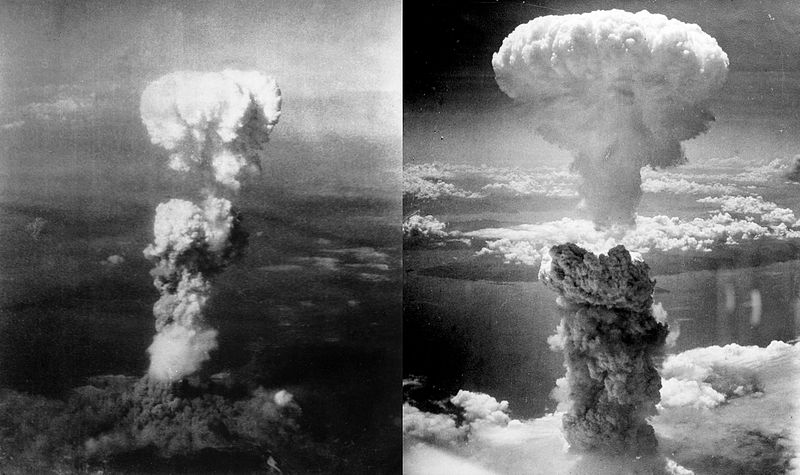
Atomic Bombs Explosions (Photo: Charles Levy)
As we face the refugee crisis in Europe, we are reminded that the ambition, greed, hatred and fear of a few can sow the seeds of suffering for thousands who were born in the wrong place at the wrong time.
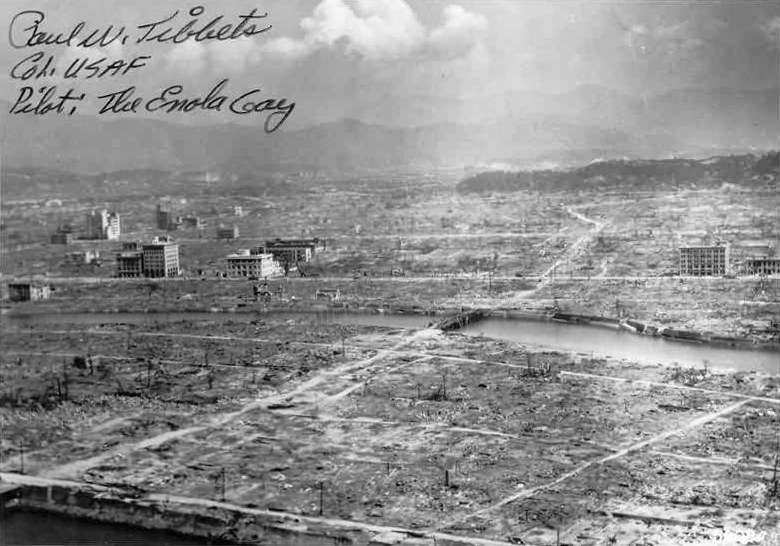
Hiroshima After the Bombing
Even after thousands of years, we still have trouble resolving differences and conflicts through negotiations and compromises. Too often, we believe in “winner takes all” and assume that the victor must vanquish his enemy to prevent revenge and secure permanent victory. Millions have died in Europe and Asia during W.W. II, but today, seventy years later, conflicts that kill and displace civilians continue. Force that induces fear to stop violence is double-edged sword, and it has led to greater violence. In light of our current condition, stories in Hersey’s Hiroshima, like other accounts of war casualties, remind us that we have to work harder toward becoming more civilized.

Hiroshima Peace Memorial
Leonard Seet is the author of the novels Magnolias in Paradise and Meditation On Space-Time. His short fiction have appeared in the Quarterly Literary Review Singapore, Banana Writers and Pilcrow & Dagger. Through his writings, he probes the dynamics of existence, including human consciousness, good and evil, and rationality and spirituality.
He received the B.S. in Physics and B.S. and M.S. in Electrical Engineering and Computer Science from the Massachusetts Institute of Technology, and an MBA from Georgetown University.
Truman Capote's In Cold Blood Review
Haunting, chilling, inconceivable, In Cold Blood, thanks to Truman Capote’s creativity, reads like fiction. If the killings hadn’t happened, the book would have required great imagination. Indeed, in this case, the truth is stranger than fiction.

Charming, gregarious, streetwise, Richard Eugene Hickock couldn’t empathize; others only existed to satisfy him. He enjoyed food, women and other pleasures in life. He passed bad checks to support his ideal lifestyle. He wanted to rob the Clutters for the same reason and even if he didn’t get the money, he wanted to rape the girl.
Moody, shy, erratic, Perry Edward Smith reacted against imagined slights toward his victims as if he were avenging himself of his father or mother who had abandoned him or of the nuns who had abused him. He never felt comfortable in his skin or in the world and he found solace in his dreams where a yellow bird would save him from his abusers. He agreed to rob the Clutters so he could get enough money to go to Mexico and hunt for treasures. He could be sentimental as when he prevented Hickock from raping the girl but he was the one who slashed Herbert Clutter’s throat. Not because there was no safe or money, but just from impulse that he seemed unable to control.
 Lansing Correctional Facilities (Formerly Kansas State Penitentiary) (Photo: Americasroof at Wikimedia Common)
Together, these two criminals slaughtered the Clutter family for less than fifty dollars and a radio. They changed the lives of the Clutters’ relatives, friends and acquaintances, and shocked the nation. Cold-blooded they were indeed.

Capote presented the events surrounding the killings with such details that we might wonder whether we’re indeed reading fiction. But these details impress upon our minds the brutality of the crime and the criminals’ lives on the fringes. Capote profiled these criminals’ backgrounds and thoughts with such clarity that we could only marvel at these twisted minds. From the tragedy of the Clutter family, Capote has created an American classic.

The Clutter Home at Holcomb, Kansas (Photo: Spacini at Wikimedia Common)
Charming, gregarious, streetwise, Richard Eugene Hickock couldn’t empathize; others only existed to satisfy him. He enjoyed food, women and other pleasures in life. He passed bad checks to support his ideal lifestyle. He wanted to rob the Clutters for the same reason and even if he didn’t get the money, he wanted to rape the girl.
Moody, shy, erratic, Perry Edward Smith reacted against imagined slights toward his victims as if he were avenging himself of his father or mother who had abandoned him or of the nuns who had abused him. He never felt comfortable in his skin or in the world and he found solace in his dreams where a yellow bird would save him from his abusers. He agreed to rob the Clutters so he could get enough money to go to Mexico and hunt for treasures. He could be sentimental as when he prevented Hickock from raping the girl but he was the one who slashed Herbert Clutter’s throat. Not because there was no safe or money, but just from impulse that he seemed unable to control.

Together, these two criminals slaughtered the Clutter family for less than fifty dollars and a radio. They changed the lives of the Clutters’ relatives, friends and acquaintances, and shocked the nation. Cold-blooded they were indeed.

Truman Capote (Photo: Eric Koch / Anefo; Nationaal Archief)
Capote presented the events surrounding the killings with such details that we might wonder whether we’re indeed reading fiction. But these details impress upon our minds the brutality of the crime and the criminals’ lives on the fringes. Capote profiled these criminals’ backgrounds and thoughts with such clarity that we could only marvel at these twisted minds. From the tragedy of the Clutter family, Capote has created an American classic.
Leonard Seet is the author of the novels Magnolias in Paradise and Meditation On Space-Time. His short fiction have appeared in the Quarterly Literary Review Singapore, Banana Writers and Pilcrow & Dagger. Through his writings, he probes the dynamics of existence, including human consciousness, good and evil, and rationality and spirituality.
He received the B.S. in Physics and B.S. and M.S. in Electrical Engineering and Computer Science from the Massachusetts Institute of Technology, and an MBA from Georgetown University.
Subscribe to:
Posts (Atom)